As I step into my 36th year in education and reflect on the autumn in 2000 when a remarkably trusting group of governors handed a 31‑year‑old Head the keys to a semi-rural Kent school, I find myself thinking more deeply than ever about school transformation and the alchemy that turns possibility into excellence.
My journey since then has been varied and energising: three turnaround headships, time as an adviser supporting schools inLambeth, and a period at the Harris Federation as Executive Headteacher, whereI led a large 700‑pupil primary while opening a five-form entry primary academy on the same campus. Later, as Assistant Director of Primary Education, I oversaw a cluster of London schools – a next level challenge - before taking up my current role in 2024 as Chief Education Officer at Authentic Education. Authentic is a MAT of five secondaries, six primaries, and two all‑through SEMH specialist academies.
In all these roles I have worked to achieve the sustainable improvements that governors, local authorities, academy trusts, and dioceses rightly expect. Over time, and often through my mistakes as much as from my successes, I’ve learned to balance short and longer term goals, how to deliver tough messages with care, to lead rapid change without losing compassion, and how to build the culture that allows for personal growth, collaboration and empowerment through shared vision and values.
I’ve been privileged to work with Andy Buck and the Leadership Matters team for around twelve years. Andy’s thinking shaped how I developed leadership in my middle leaders early on in my ExecutivePrincipal days. The ‘discretionary effort’ concept - this wonderful, almost magical phenomenon where good people stretch themselves into extraordinary performers - has stayed with me ever since.
Some colleagues who know my Leadership Matters Ambassador work, or who heard my 2023 talk at the Farmington Institute Primary Headteacher group, may remember my paper on legendary football manager Brian Clough.Charismatic, provocative, and belligerent, Clough took a Nottingham Forestside struggling in the lower half of the old 2nd Division, toa 1st Division (Premier league) title and two successive European Cup trophies (European League) all within two years and with minimal squad changes.
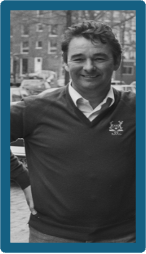
Clough understood people. He kept things simple. Heinspired belief in himself, in his players, and in a shared way of playing. He knew how to lift people, how to challenge them, and how to draw out their best. His genius lay in creating the climate where discretionary effort flourished.
Andy Buck’s model, which our middle leaders worked with across my Harris academies, sits beautifully alongside Clough’s philosophy.
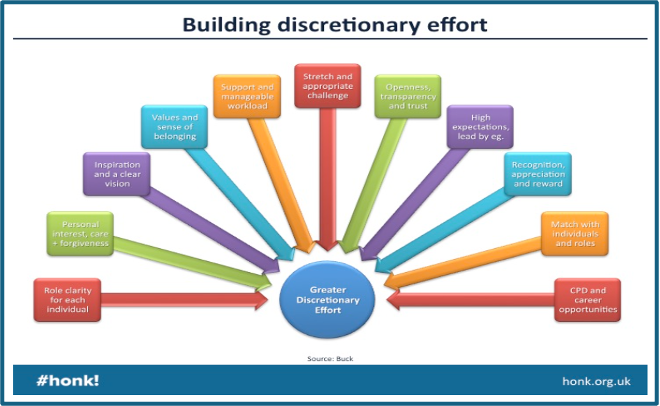
In my early years of leading rapid improvement, like Brian Clough, I focused on clarity: a simple tactical vision that everyone understood. That meant clear expectations, honest feedback, and absolute transparency about why things needed to change.
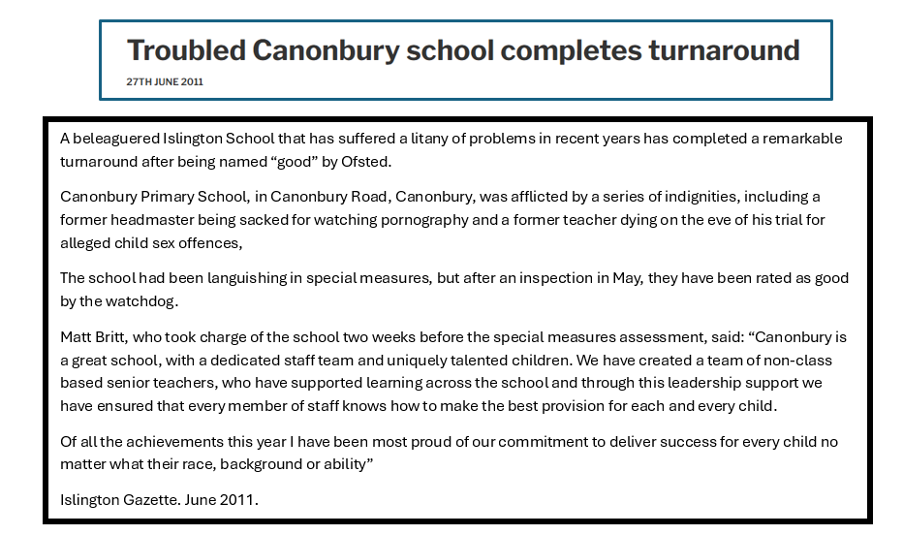
When I arrived at Canonbury Primary in Islington in 2010,the school had just been placed in special measures. Staffing had grown in coherent and leaderless, with too many support roles filling gaps, and inconsistent teaching. We had to completely restructure, removing 30 posts and building a new leadership structure, appointing middle and senior leaders to transform teaching and learning.
It was painful, and staff were understandably unhappy. It wasn’t their fault they had been caught up in the ineffective leadership which had led to the school’s decline. The only way through was to explain everything with honesty and kindness. I produced an improvement brochure for staff and parents and spoke constantly about my belief in them, in the children, and in our ability to turn things around. At times, I didn’t feel remotely confident butI projected certainty because people needed it. I went back atthis time to Clough’s model of shaping self-belief, setting timescales for improvement that showed my conviction, with governors,parents, staff, local councillors and indeed anyone who’d listen.
I personally led every consultation meeting and sat on every interview panel. I never pushed hard conversations or decisions onto anyone else. It was important to me that nobody saw me duck thedifficult moments. With strong support from governors, HR, and constructive engagement from union colleagues, we pushed through. Coaching became relentless. Standards rose. And within 13 months, Canonbury moved from Special Measures to Good.
Looking back, what I didn’t yet do well enough wasbuild values as the foundation stones of culture. I had a clear vision,and I could articulate why it mattered for children, butI didn’t spend enough time building the shared values that underpin that vision, the ‘how we do things here’ that enables consistency, belonging, and long‑term cultural strength.
The schools improved, and progress was sustained. But I sometimes felt like I was fighting the inherited culture rather than instilling values and coaching staff into these as rigorously as I hadwith improving the quality of teaching. I now know values needed to sit at the heart of everything, co-created, lived, and owned.
My time as an Executive Principal and later Assistant Director at the Harris Federation changed everything.
At Harris learning, collaboration, and teamwork were the heart of the organisation. Leaders at every level modelled the Trust’s values through their relationships; sharing learning from each other was built into the DNA. I thrived as a system leader in this environment and began to understand what David Woods and Tim Brighouse meant when, in ‘How to improve your school’, they wrote ‘The first rule of leadership is that it is shared’.
Crucially, line management wasn’t just operational it was developmental,coaching-led, and anchored in those shared values.
Academies created staff, parent, and pupil values that were simple, powerful, and lived daily. A “No Gossip” expectation extended into parental WhatsApp groups. Weekly wellbeing activities became standard, and academies emphasised clear commitment to equality, bringing diverse communities together to celebrate diversity and foster unity.
None of this happened by accident. It took courage, empathy,and time. But the impact was huge: happier staff, calmer culture, greater stability, exceptional outcomes.
My role was to ensure leaders could focus on giving children an extraordinary education, because when we pulled together, we were always more than the sum of our parts. And it worked. Ofsted outcomes were consistently outstanding. Outcomes exceeded national averages year after year. Newly adopted academies improved rapidly. Things came together and extraordinary became normal.
None of this is to say that values mattered more than the daily graft: holiday interventions for vulnerable pupils, firm decisions about underperformance, residential trips, tricky parental conversations. This work is the backbone of leadership and always will be.
But values, when aligned with vision and supported through coaching, create the conditions where people can do their best work. They bring clarity, fairness, and cohesion. They unlock that magical discretionary effort.
These lessons stay with me and today in my current role, I am able to apply them to my work in a very different context. These approaches, along with inspirational line management and the leadership of those who worked for and alongside me, were what created Buck’s ‘discretionary effort’ and what helped make my time working as part of a close team with my colleagues at the Harris Federation, my very own ‘Brian Clough years,’ where barriers were broken down and some truly exceptiona loutcomes achieved.
.png)